
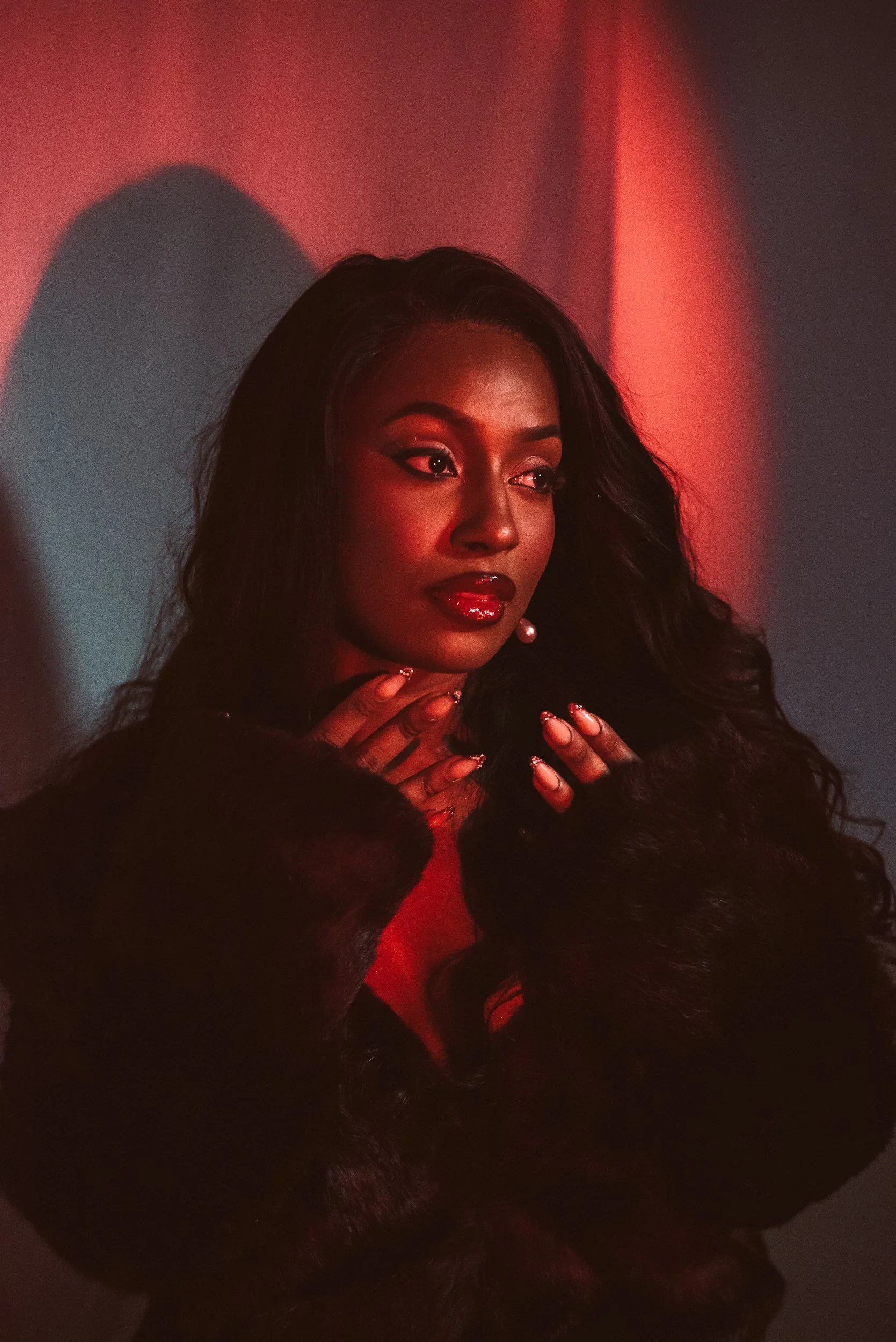
Black Women, Visibility, and Desire
Black women are taught two contradictory lessons very early in life.
Be desirable.
But don’t invite desire.
Be confident.
But not too visible.
Be beautiful.
But don’t let anyone notice too much.
This contradiction is not accidental. It is how control enters the body.
For many Black women, visibility does not feel neutral. It feels charged. Heavy. Risky. To be seen is to be interpreted—often incorrectly and aggressively. Desire arrives early, before language, before safety, before consent. And when that desire is expressed by others, the response we receive from our communities is rarely protection. It is correction.
Cover up.
Tone it down.
Be careful.
What we learn is not how to be safe.
What we learn is how to disappear strategically.
Desire was never the problem—power was
Let’s be clear: there is nothing inherently dangerous about being desired.
What is dangerous is how Black women’s desirability has been historically:
Hypersexualized
Moralized
Weaponized
Used to justify harm
Used to deny softness, innocence, and humanity
So many of us learned that if something bad happened, it would be traced back to our bodies. Our curves. Our movement. Our presence. Our audacity to exist out loud.
Desire became something we had to manage instead of something others were responsible for holding ethically.
That is too much to put on a girl.
Too much to put on a woman.
Why visibility feels unsafe even when you want it
Many Black women crave visibility and resent it at the same time.
We want:
To be admired
To be chosen
To be witnessed
To be celebrated
To be desired without being devoured
And yet our bodies remember:
Being watched too closely
Being corrected publicly
Being blamed for others’ lack of discipline
Being read as sexual before being read as human
So we brace.
We shrink our joy.
We mute our movement.
We manage our expressions.
We downplay compliments.
We armor ourselves before walking into rooms.
This isn’t insecurity.
This is learned vigilance.
You are allowed to want desire without punishment
This is important to say plainly:
You are allowed to enjoy being desired.
You are allowed to like attention.
You are allowed to feel beautiful.
You are allowed to be seen.
None of these things make you shallow, unsafe, sinful, or irresponsible.
The lie Black women are sold is that wanting desire makes us complicit in how others treat us. That if we like attention, we deserve whatever comes with it.
That is not true.
Desire does not cancel your humanity.
Visibility does not void your boundaries.
The work is not shrinking—it’s anchoring
The answer is not to disappear.
The answer is not to harden.
The answer is not to become unfeeling.
The work is to become anchored.
Anchored in your body.
Anchored in your values.
Anchored in your right to say no.
Anchoring looks like:
Receiving compliments without deflecting
Ending objectifying conversations without apology
Letting yourself be admired without yielding access
Allowing desire to exist without letting it steer the interaction
You don’t need to be invisible to be safe.
You need internal solidity.
You don’t owe anyone comfort with your body
This includes:
Men
Women
Elders
Faith communities
Strangers
Audiences
The internet
Your body is not a public negotiation.
You do not have to:
Explain your curves
Justify your confidence
Dilute your presence
Apologize for being noticeable
Your existence does not require permission.
A gentle reframe for Black women stepping into visibility
If you are becoming more visible—online, creatively, professionally, socially—here is a grounding truth to carry with you:
You can be seen without being consumed.
You can be desired without being taken.
You can be admired without being reduced.
Your job is not to control how others see you.
Your job is to stay inside yourself while being seen.
That is power.
That is freedom.
That is reclamation.