
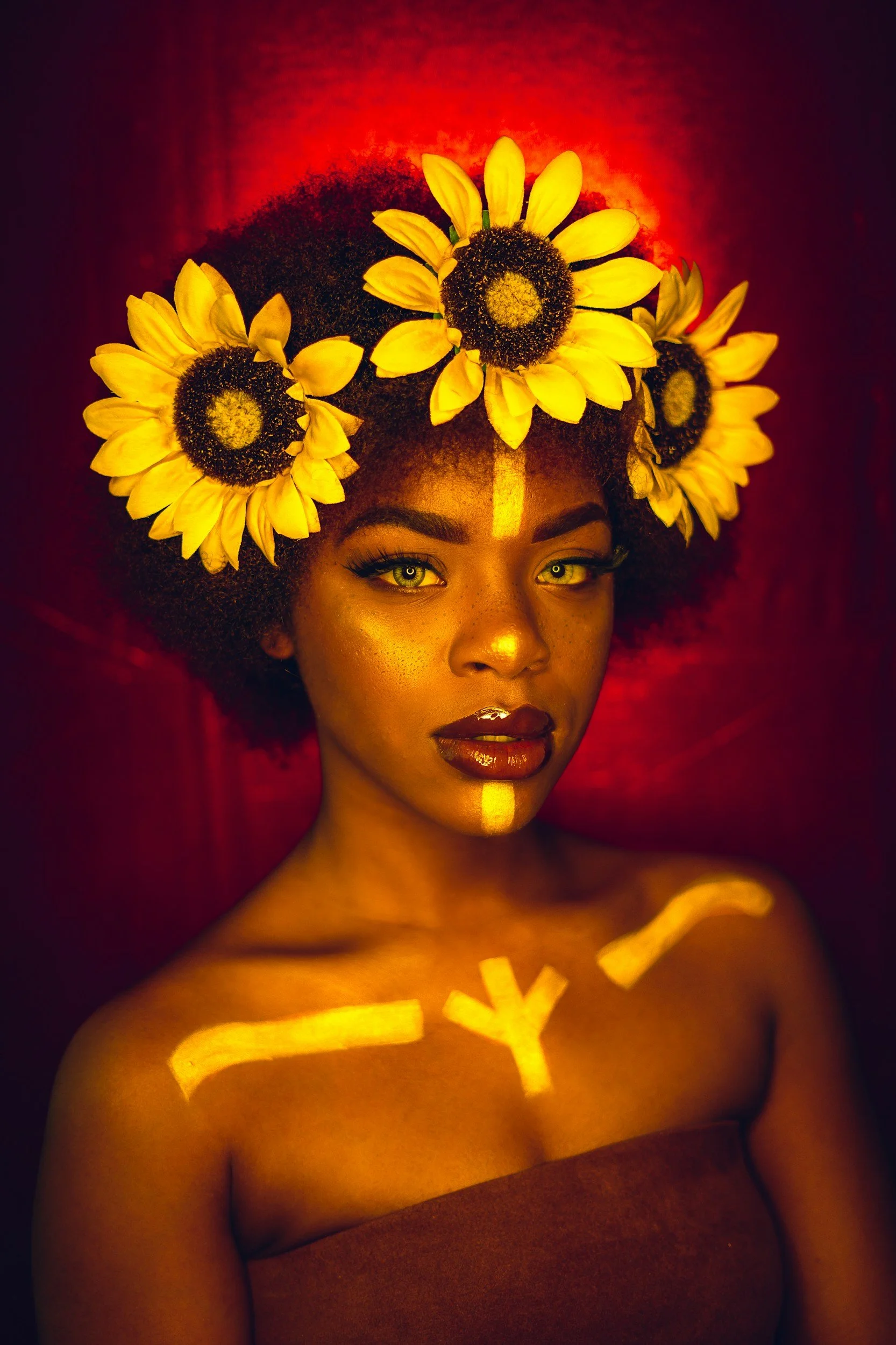
How to Make a God:
What Happens When Black Women Are Forced to Transcend
The Observation
Lately, as conversations deepen and language sharpens, something keeps surfacing:
The more clearly Black women name what they do, what they carry, and what they’ve endured — the more they begin to sound like goddesses.
Not metaphorically. Structurally.
The Evidence
Consider what Black women have consistently been required to do:
Sustain systems that actively harm them
Translate between worlds that refuse to meet them halfway
Hold emotional, cultural, and spiritual infrastructure together
Survive constant extraction without recognition
Continue creating beauty, humor, care, and vision
That is not simple “strength.”
That is mythic labor.
Calling Black women goddesses isn’t arrogance. It’s observing the data.
The Weaponized Archetype
The culture already recognizes this — it just reframes it.
That’s why Black women are cast as:
the fixer
the backbone
the savior
the “strong one”
the one who can handle it
These are divine archetypes stripped of reverence and loaded with expectation.
The catch?
Gods are expected to self-sacrifice. Think of Jesus Christ carrying the cross.
Divinity becomes a demand.
Not Superiority — Pressure
This is not a story about inherent superiority.
It is a story about position, pressure, and prolonged demand.
Black women were forced into integration in a world built on fragmentation.
Where most people are allowed to specialize — worker or caregiver, thinker or feeler — Black women were required to be all of it at once.
Survival demanded mastery across domains:
emotional
social
cultural
logistical
spiritual
Not as ambition.
As condition.
Integration looks supernatural in systems that collapse under contradiction.
Clarity Under Constraint
Placed close enough to power to see how it operates — but barred from its protection — Black women developed pattern recognition others never had to.
Reading rooms.
Anticipating fallout.
Managing emotional climates.
Speaking truth carefully enough to survive it.
This is not mysticism.
It is clarity under constraint.
Creation Under Threat
Black women did not just endure harm. They created within it.
Language.
Culture.
Humor.
Joy.
Care networks.
Beauty under pressure.
Most people create from safety. Black women created from necessity. Creation under threat looks magical.
The Paradox Capacity
Black women have been required to hold:
rage and tenderness
grief and laughter
realism and hope
Simultaneously.
Where systems split, Black women metabolized.
Where institutions externalized pain, Black women internalized responsibility.
In a world addicted to binaries — strong or soft, logical or emotional, victim or hero — this capacity reads as divine.
But it was never meant to be sustainable.
Training Under Fire
Black women are not the only ones capable of this level of integration.
They are the ones most consistently forced into it.
Other groups were shielded from this pressure, collapsed under it, or outsourced the labor.
When one group carries disproportionate weight long enough, they develop capacities others never had to.
That is not destiny.
That is training under fire.
When Divinity Appears in Myth
Across traditions, divinity often emerges during crisis — not comfort.
When injustice peaks.
When systems collapse.
When imbalance spreads.
Consider:
Jesus Christ (Christianity)— divinity embodied in sacrifice under empire
Kali (Hinduism)— appearing when chaos requires violent correction
Atlas (Greek Mythology)— mythologized for bearing an unbearable structural burden
Amaterasu (Shinto)— whose withdrawal plunges the world into darkness
Oshun (Yoruba Cosmology)— whose exclusion causes creation itself to fail
In these stories, divinity exposes dependency.
It signals that something has required superhuman endurance to compensate for systemic disorder.
Divinity appears not as reward — but as warning.
The Warning Embedded in “Goddess”
When Black women start sounding mythic, it is often because:
They have been carrying what systems refused to hold.
Their withdrawal reveals structural fragility.
Their endurance has been normalized beyond reason.
The goddess language is not ego.
It is exposure.
And in myth, divine figures do not carry forever.
They withdraw.
They destroy.
Or they demand reordering.
The Refusal
Black women did not become goddesses because they wanted to.
They became godlike because survival required transcendence.
But survival should not require godhood.
Now — quietly, collectively — that requirement is being refused.
The goal is not to eternalize Black women as divine infrastructure.
The goal is not to keep praising resilience while depending on depletion.
The goal is to end the conditions that demanded godhood in the first place.
Because the future cannot be built on Black women needing to be more than human to survive.
Once you see that, you cannot unsee it.
Of course the system feels shaky when Black women withdraw.
Of course “culture” collapses.
Of course opting out looks like rebellion.
Because when the gods stop holding the sky up —
the sky finally falls.